Navigating the Chaos: Molly Graham's Essential Frameworks for Rapid Career Growth
I recently had the incredible opportunity to dive deep into the mind of Molly Graham, a true veteran of hyper-growth companies like Google, Facebook, Quip, and the Chan Zuckerberg Initiative. Listening to her on Lenny's Podcast, I was blown away by the wisdom she's distilled from years of making "every single mistake in the book" and then inventing new ones. This isn't just a summary; it's a treasure trove of actionable frameworks and mindsets that Molly has developed and collected over time to help leaders not just survive, but thrive in environments of rapid scale and constant change. This episode truly felt like a high-growth handbook for anyone experiencing the exhilarating, yet often terrifying, ride of a quickly expanding company.
Molly's journey began in tech in 2007, joining Google the week the iPhone launched. Her department there grew from 25 to 125 people in just nine months, giving her a potent first taste of rapid scaling. She then spent five pivotal years at Facebook, joining in 2008 when it had 80 million users and 500 employees, feeling far from "inevitable." By the time she left, it boasted over a billion users and 5,500 employees. After Facebook, she sought to build "something from nothing" at Brett Taylor's startup, Quip, running everything outside product and engineering until its sale to Salesforce. Her final chaotic scaling experience was helping Mark Zuckerberg and Priscilla Chan launch the Chan Zuckerberg Initiative, where it grew from 30 to 250 people in its first year.
From these intense experiences, Molly has made a personal study of what it takes to thrive in changing environments, lead through constant flux, and differentiate generational businesses from those that plateau. Her goal is to equip leaders with tools that work and to be honest about how challenging it all truly is. What resonated deeply with me is her philosophy on career growth:
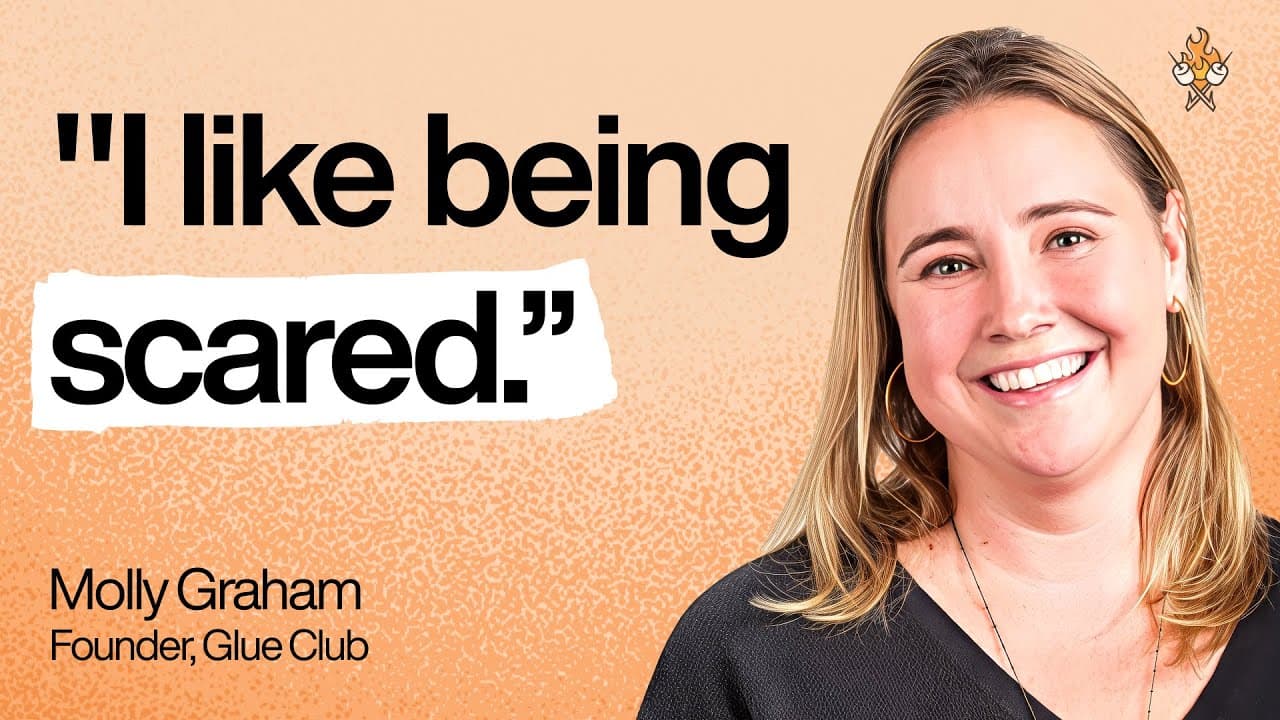
"I only like doing jobs that I'm highly unqualified for. I like being on learning curves so steep that I'm scared I'm going to fall off."
This mindset of embracing discomfort and constant learning is a recurring theme in her frameworks, which I'm eager to share.
The J-Curve vs. Stairs Career Growth Framework
This framework, which Molly even gave a TED talk about, is incredibly impactful for career growth, especially in dynamic environments. It originates from a pivotal conversation Molly had with Chamath Palihapitiya at Facebook.
Molly was comfortable in HR, planning to stay until Facebook went public. Chamath, then running growth and mobile, directly challenged her: "you're useless what are you doing in HR." He eventually offered her a crazy opportunity: "I'm going to go build a mobile phone. Do you want to come do you want to come do that with me?"
Despite wise people advising against it (Cheryl Sandberg thought the project would be "dead in two months"), Molly took the leap. The next six months were brutal:
"I spent the next six months feeling like an absolute idiot. Like, I basically felt like a total jackass all the time. And I was sitting in rooms with these like brilliant people, you know, asking the dumbest questions of my life. And at the end of the six month, Chimath, I think, took a lot of pride in giving me like the lowest performance rating I've ever gotten in my life. Um, and you know, it just felt like falling off a cliff."
But then, a shift occurred. She started to "actually know things," eventually becoming a mobile expert. While the phone itself was a "massive costly failure for Facebook," it was a huge success for Molly personally, teaching her she was "capable of things that I never could have dreamed of if I had stayed in HR." She went on to work in product, business development, and hardware at Facebook, none of which she would have been hired for initially.
Chamath's pitch to her illustrated this concept with a drawing:
"The way a lot of people do careers is a set of stairs. You can be boring to use Jamal and stay on these stairs. Just walk up the stairs and you'll get promoted every two years and your title will change from manager to senior manager to director to senior director, whatever. And he was like, 'But that is boring.' And he's like, 'The much more fun careers are like jumping off cliffs basically that you jump off this thing and you do fall, you know, for a period of time. I always like to say it's about 6 to 9 months, but then this thing happens where you climb out.' And, you know, the picture he drew had this J curve sort of like basically leading you to places that are way beyond where the stairs could ever get you."
This J-curve experience, embracing the "terrible fall," has been Molly's path to places she "could never have imagined."
Distinguishing Fears: When to Listen and When to Leap
The idea of "jumping off a cliff" can be terrifying. Molly advises distinguishing between different kinds of fear:
-
Financial Fear: This is the concrete fear you should listen to.
"You got to do the math... What is the number that you need to hit so that you're not constantly terrified financially? And that number is, you know, wildly different for people based on their background and their life." Do the math on your "burn rate" – what can you afford to live on without income for a period, and do you believe you can secure consulting or other income if needed? "Specific financial anxiety is much more useful than existential financial anxiety."
-
"I'm Scared I Can't Do This" Fear: This is the fear you should lean into.
"That's the kind of fear that I think of as like a flashing green light cuz I'm like that... that's the kind of fear that's saying why don't you go prove to yourself that you are actually capable of this or if you fail like you'll have learned something too." This is about self-discovery. Molly learned she wasn't a good "button-caring" product manager, but she gained a "great product mindset" and a deeper understanding of herself. "Knowing yourself better and knowing where you go next from there" is one of the greatest gifts of a career.
Embracing the "Professional Idiot" and the "10x Learner"
During the "falling phase" of the J-curve, which Molly estimates to be about 6 to 9 months, the most valuable thing you can do is learn.
"The most important thing to do in the falling phase and the risk-taking land is to learn to embrace being a professional idiot... Basically being the one that shows up at the meeting and is like, what are we talking about? Like what does that word mean?"
This superpower of asking "dumb questions" allows you to learn immensely, and often, those aren't dumb questions at all – everyone else might have the same query but lack the courage to ask. This concept ties into being a "10x learner," not just a "10x PM."
"What you know today is way less valuable than what you can learn by tomorrow. If you're inside of a company where the growth curve is like this, what you know today is like irrelevant."
Continuous learning and evolution are critical to staying relevant and avoiding extinction in a rapidly changing world driven by technology like AI.
The Waterline Model
Molly didn't invent the Waterline Model; she learned it during her time leading wilderness trips for the National Outdoor Leadership School (NOLS), where it was taught as a tool for leadership and communication. It's incredibly useful for diagnosing team issues.
The metaphor:
- A team is a boat on an ocean, trying to get somewhere (achieve goals).
- The shape of the ocean (choppy or calm) represents external challenges affecting goal attainment.
- The waterline is the critical boundary: what's happening under the water that makes reaching goals harder or easier?
There are four levels beneath the waterline, in descending order of depth:
- Structural: This is the surface level, encompassing things like goal setting, vision, roles, and expectations. These are the explicit structures that impact every team member.
- Dynamics: How the team works together – culture, decision-making processes, conflict resolution, interweaving pieces of collaboration.
- Interpersonal: Relationships between two individuals on the team, and the human elements that come with that.
- Intrapersonal: Challenges or issues within one single person.
The Rule: "You Snorkel Before You Scuba"
This is the most memorable and actionable part of the model.
"Most people when we when something's going wrong on a team, a lot of times we always go to the bottom. We go to the people. We're like, the people aren't getting along, that person's having a rough moment, we go to the humans. But the rule with the waterline model, which is very memorable memorable, is you snorkel before you scuba. So 80% of problems on teams actually happen because of structural issues or dynamics issues. So when there are problems on your team, where you start is at the top."
Molly's biggest piece of advice for managers:
"Your only goal as a manager if you do nothing else is clear roles and clear expectations. That's it."
She's found that in many teams she's taken over, people don't know their job or what success looks like. Clarifying these "snorkel level" issues can resolve a huge percentage of team problems.
Practical Application for Managers
When encountering performance issues or team problems, Molly recommends a two-sided dialogue:
- Start with observations: "Hey, here's what I'm seeing."
- Seek their perspective: "Tell me what's going on for you. Do you know XYZ? Tell me what you know."
- Clarify roles and expectations: Often, what you think is clear isn't. "You described an elephant and they spat out a tiger." The manager's job is to continually "redescribe the elephant over and over and over again," making sure people understand their specific role (e.g., "You're in charge of the trunk") and how it ties to the company's overall goals. This is hard work because you feel like a "broken record," but it's essential for people to hear and internalize.
By focusing on clear goals, roles, and expectations first, managers address the most common root causes of team dysfunction before diving into deeper, interpersonal issues.
Actionable Takeaways for Leaders in Rapid Growth
Molly Graham's insights provide a powerful blueprint for anyone navigating a fast-paced career or a rapidly scaling organization. Here are my key takeaways:
- Embrace the Learning Curve: Seek out challenges where you feel "highly unqualified" and "scared." This discomfort is where the greatest growth happens.
- Give Away Your Legos: Actively shed responsibilities you've mastered to take on new, larger challenges. Understand that the emotional attachment is normal ("Bob the Monster"), but don't let it hinder your growth or the company's. Always aim to "grow as fast as your company is growing."
- Jump Off Cliffs (Wisely): Pursue "J-curve" career paths over the "stairs." Be prepared for a 6-9 month "fall" where you might feel like an "idiot." Distinguish between financial fears (address them practically with a "burn rate" calculation) and capability fears (see them as "flashing green lights" to prove yourself).
- Become a "Professional Idiot" and a "10x Learner": Ask "dumb questions," be curious, and prioritize learning above knowing. What you can learn is more valuable than what you already know in a changing world.
- Snorkel Before You Scuba: When team problems arise, resist the urge to immediately blame individuals. Start by examining "structural" and "dynamics" issues.
- Prioritize Clarity: As a manager, your primary goal is to ensure "clear roles and clear expectations." Continuously communicate and clarify what the team is building, individual responsibilities, and what success looks like. "Redescribe the elephant" as often as needed.
- Embrace Change: Fighting change rarely works; stepping into the future, even if uncertain, often leads to unexpected opportunities and deeper self-knowledge.
Molly's frameworks offer not just strategies, but a mindset for embracing the inherent chaos and opportunity of growth. By adopting these principles, we can move beyond merely "hanging on for dear life" and truly thrive as leaders in dynamic environments.