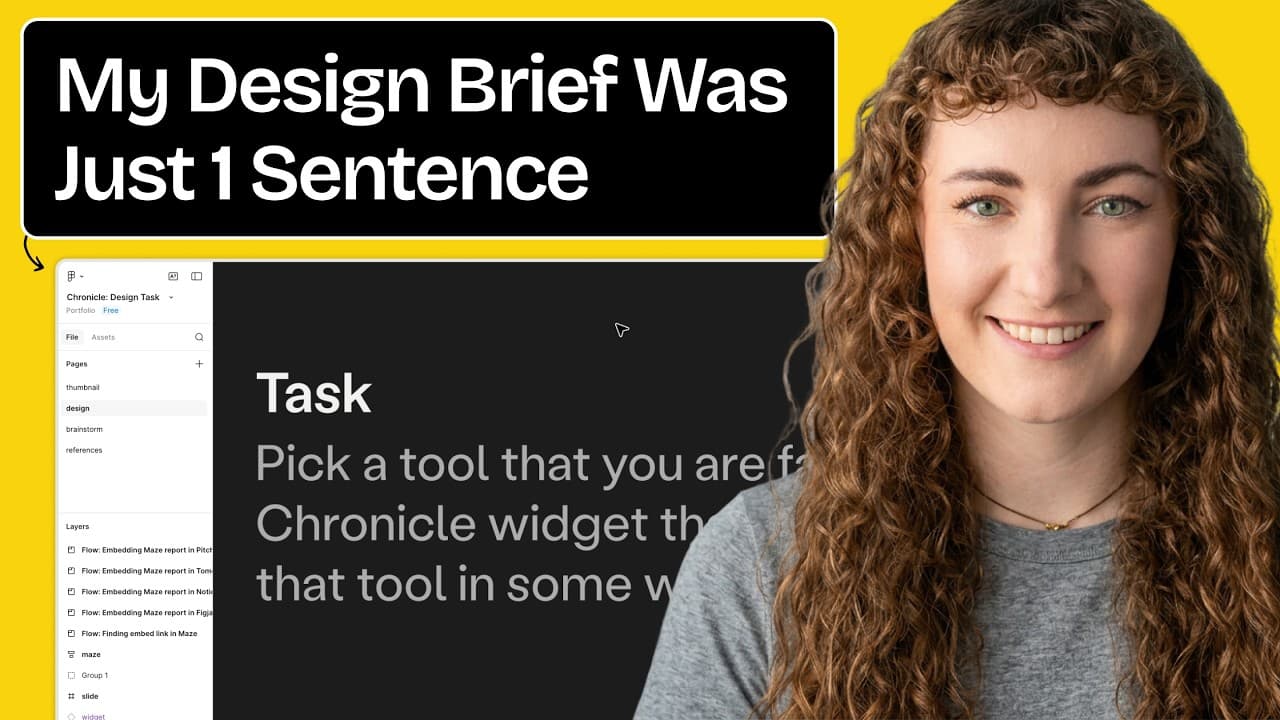
Solving a Startup Design Challenge: My Path to Becoming Head of Design at Chronicle
Landing a design role at a fast-paced startup can be an exhilarating journey, often involving unique challenges that test not just your design skills, but your ability to thrive in ambiguity and a zero-to-one environment. Recently, I shared my experience and insights on the Sneak Peek channel about how I tackled a take-home design challenge, structured my portfolio, and what I look for when evaluating a startup as a designer.
Crafting a Portfolio That Stands Out
My portfolio journey started with Vizzero, but I quickly pivoted to building a custom site with the help of my front-end engineer husband. I wanted something brief and quick, focusing on subtle interactions: a blur animation on refresh, theme changes on click (I'm picky, only purple and green!), and a custom cursor takeover on hover.
I believe that showcasing side projects is especially crucial when aiming for a startup role. It demonstrates an entrepreneurial mindset and a willingness to tinker, play, and try new things. My side projects, like the wine tasting app "7oz Computer" and the festival management tool "Stagecraft," highlight how I'm constantly thinking about introducing new features and recording ideas.
When it comes to case studies, keeping them updated has always been a struggle. I used to rely on Figma for my case studies because it allowed me to embed prototypes directly, making static marks interactive. Now, I'd probably use a password-protected Chronicle workspace for this, as Chronicle supports embedding Figma prototypes, Claude, or V0 designs.
My strategy for case studies often involves both embedded prototypes and GIFs. This provides a backup in case the interactive element breaks, and the motion of a GIF instantly draws the eye, ensuring that my UI skills are apparent at a glance, especially important as a senior designer who might otherwise lean too heavily into strategy. My aim is to show I know good design and good slides, without too much preamble, getting straight into the story with imagery and diagrams.
The visual style of your portfolio is also key. I meticulously tailor my portfolio's design to align with the company I'm interviewing for. I ask myself:
"If I was the head of design at this company and I saw this person's portfolio would does it match our taste? Does it match our style?"
For Chronicle, this meant a minimalistic, dark mode aesthetic with purple hues and a bubbly design style, which matched both Chronicle's early branding and an app I was working on at the time. I also make an effort to update my portfolio annually, constantly trying new things and adapting its vibe to suit different companies, whether it's the playful style of a company like Canva or the more professional look of another.

Navigating the Interview Process and Acing the Design Challenge
My journey to Chronicle began with a LinkedIn DM. A recruiter from Aetree Ventures (who also funded my previous company) reached out, connecting me to Chronicle, which was seeking a designer. This highlights the importance of professional networks.
The interview process at Chronicle typically starts with a "vibe check" to assess if you can thrive in a "zero-to-one environment" – handling ambiguity, taking ownership, and driving outcomes without constant direction. The design challenge is central to this assessment.
The task I was given was incredibly concise, almost a single sentence:
"pick a tool that you're familiar with and design a Chronicle widget that shows like embedding that tool within Chronicle."
They allocated a week for the task but explicitly stated I should spend "no more than 4 to 5 hours on it." This emphasizes the startup's need for speed and efficiency.
My approach to the challenge involved several steps:
-
Deconstruction: I started by breaking down "what is Chronicle" and "what is a widget," understanding how it might work, even though Chronicle wasn't in public beta. I had to infer details from their landing page.
-
Tool Selection: Instead of common choices like Figma prototypes or Notion databases, I decided to "go against the grain" and pick something they might not have considered: Maze for usability testing. I researched how Maze is embedded in tools like FigJam and Notion for inspiration.
-
Minimalist Design System: I quickly established a light design system to get started, maintaining a dark, minimal aesthetic consistent with Chronicle's early branding.
-
Interactive Components: To make the design feel realistic, I created classic interactive components.
-
Going the Extra Mile: The task only asked for a widget, but I pushed further:
"I went that extra mile and just thought about that little extra piece. The betting flow how it the whole flow"
I designed the entire embedding flow:
- A loading state that would animate when a URL was pasted, circling with Chronicle's purple gradients.
- Hover interactions for dragging, deleting, cycling through different previews, and resizing the widget.
This detailed thinking about the user experience beyond the core requirement significantly impressed the founders and was a key factor in my hiring.

Evaluating a Startup: Questions Every Designer Should Ask
Joining a startup is a significant commitment, so it's vital to assess if it's the right fit for you. Here are some critical questions I ask:
- Financial Health:
- "burn rate"
- "what's your runway"
- Team Growth & Sustainability:
- "what are your plans for hiring in the team?"
- Rapid hiring (e.g., a new engineer every week) can be a "red flag," as it often leads to redundancies after a funding round. I've personally experienced this twice and it's something to avoid.
- "growth plans and if that feels sustainable."
- Investor Influence:
- Research the VCs backing the startup. Are they "grow at all costs" investors, or "visionaries" who allow the team "the time to experiment and get this thing right"? We're fortunate at Chronicle to be backed by Excel, who are truly partners on the journey.
- Team Dynamics & Decision-Making:
- "how the team works" (recognizing that processes evolve with new hires).
- "how closely I'm working with the founders"
- "how decisions get made" – Is it top-down, or collaborative? This is a very telling question.
Regarding work-life balance, while it might be assumed startups demand 70-hour weeks, I've found it varies. At Chronicle, our philosophy is that you're an adult capable of managing your own time. We encourage transparency – openly stating if you're "not at my A game today." Some startups even offer mental health leave. While some team members might experiment with working weekends, it's not an expectation, and we proactively encourage taking time off to balance it out. You can often "catch" the answer to this without directly asking by observing the culture.

Balancing Side Projects with Startup Life
Many designers, like myself, have passion projects outside of their full-time roles. The question often arises: can these co-exist with the demanding nature of a startup? My experience at Chronicle has been incredibly positive. I've worked on my side projects more than ever, largely because it's encouraged within the culture. We share our weekend achievements in random channels, and everyone uplifts each other's successes.
It's crucial to check your employment contract to ensure your side projects are permissible and that your company doesn't claim intellectual property (IP). I typically maintain separate laptops and ensure clear boundaries. In my experience, startups are often more open-minded about side projects than larger corporations, viewing them as a form of "L&D budget" – an opportunity for you to learn and apply those learnings back to the company.
At Chronicle, my side projects even serve as valuable "fodder." I use Tasting Notes to create pitch decks and Stagecraft to build sales proposals within Chronicle itself. This allows me to use the product in a real-world scenario, identify "cracks," and contribute to its improvement.
My advice for others considering a startup is to "try it out." There's no certainty in any company, regardless of size; layoffs can happen anywhere. Why not pursue a project you're passionate about and inspired by? The drive and energy in a startup can be incredibly rewarding.
For designers transitioning from large enterprise organizations, it's true that some startups might prefer candidates with "been there, done that" experience in small, fast-moving environments without product managers. However, I don't discount people from large organizations. They often bring a different kind of drive and experience. The biggest factor for me is mindset – adaptability, ownership, and a willingness to operate in ambiguity are paramount.
Actionable Takeaways
- Strategic Portfolio Design: Tailor your portfolio's visual style to the target company. Use both interactive prototypes and GIFs for impact and redundancy in case studies.
- Show Entrepreneurial Spirit: Highlight side projects to demonstrate initiative, learning, and a passion for creating.
- Master the Design Challenge: Break down vague prompts, choose unconventional solutions, and go the extra mile by designing the full user flow, not just the core request. Prioritize speed and efficiency.
- Critically Evaluate Startups: Ask probing questions about financial health, sustainable growth, investor influence, team dynamics, and decision-making processes. Observe the culture to gauge work-life balance.
- Embrace Side Projects: If culturally supported and contractually allowed, side projects can foster learning and even contribute to your main role.
- Mindset Over Background: Regardless of previous experience (agency, large enterprise), a startup mindset – adaptable, driven, comfortable with ambiguity – is key to success.