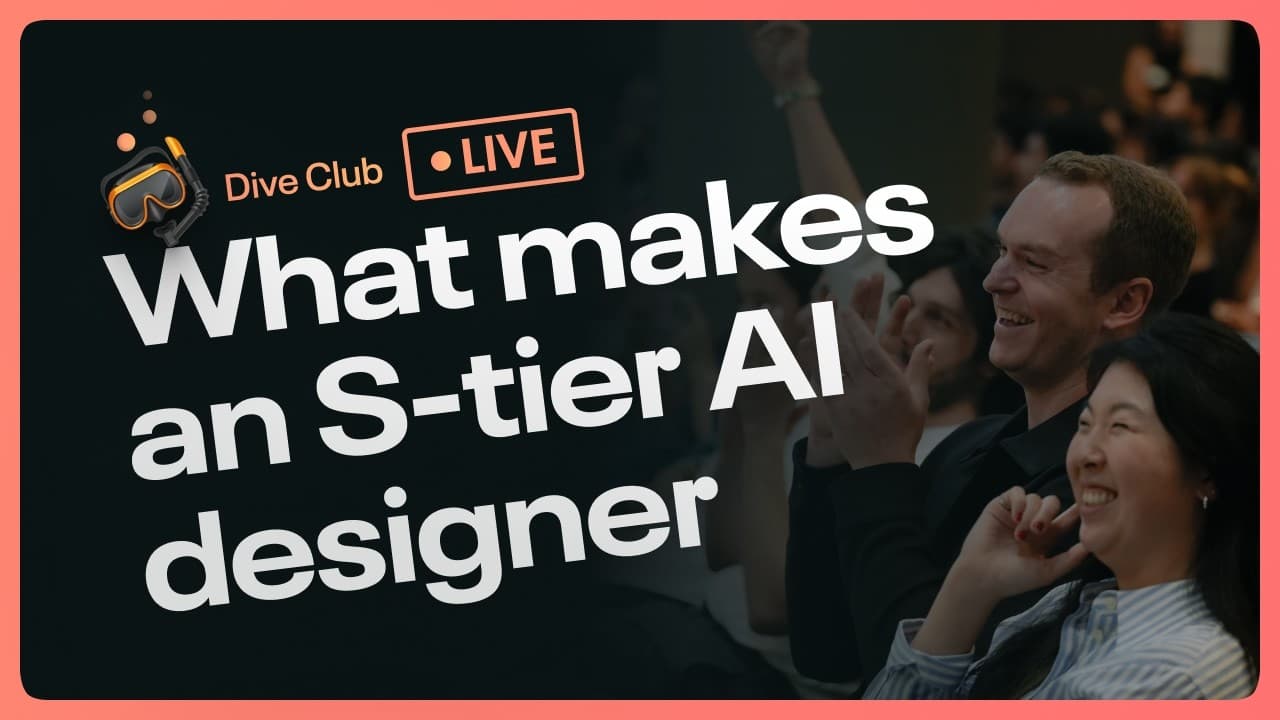
Navigating the AI Frontier: Insights from Anthropic, Every, & Ramp on the Future of Design
I recently had the opportunity to attend a panel discussion featuring Megan Choy (Design Lead for Claude at Anthropic), Dan Shipper (CEO of Every), and Bradley Zipper (Design Engineer at Ramp). The conversation offered a deep dive into the evolving landscape of design and AI workflows, providing invaluable insights into how organizations can transform their building processes with artificial intelligence.
Megan Choy, who frequently leads onsite training for design organizations on effectively using Claude and AI, highlighted two pivotal milestones for design organizations embarking on their AI journey.
Embracing AI in Design: Two Key Milestones
Milestone 1: Granting Designers Access to Production Codebases
Megan stressed the critical importance of designers having direct access to the production codebase. Historically, this has been a restricted area due to security and privacy concerns. However, with the advent of AI tools, direct access has become paramount for effective building.
"Let your designers get access to your production codebase. That's like the starting point of this conversation. It is been a very gatekept and for a lot of good reasons for security, for privacy, for like your ability to understand that you're making these changes. It's been segregated for a while, but it's so so so important now that these tools are available and like the more information access they have, the better you'll be able to build to get access to that production code to go through the process of shipping to production because the closer you are to what your end users see, the closer you have to like influence the product."
She strongly advised against creating separate repositories or sandbox environments for designers, explaining that such an approach leads to:
- Maintenance Burden: Maintaining two distinct codebases is inherently inefficient, resulting in increased maintenance and often outdated versions.
- Limited Functionality: A sandbox cannot replicate the full suite of organizational tools, actual data endpoints for logging and queries, or the comprehensive ecosystem of a real production codebase, all of which are crucial for truly impactful product development.
Milestone 2: Designers Learning to Let Go of Control
The second, often uncomfortable, milestone for designers involves relinquishing a degree of control. This entails recognizing that many features can be shipped, reaching V1, V2, or even V3, with a "pretty good" level of quality and alignment to the design system, even without direct, minute-by-minute designer intervention.
"You need to be more comfortable letting go of design. And that means that a lot of features can go out without you. A lot of the time, it's actually very possible for people to get a V1, a V2, even a V3 out there and have it be pretty good and have it be pretty aligned with your design system."
This shift requires a fundamental change in mindset, acknowledging that AI empowers everyone to build, and responsibilities are becoming increasingly fluid and shared.
Design Engineering Collaboration & Time Allocation in the AI Era
Bradley Zipper, a design engineer at Ramp, shared his perspective on how design engineering collaboration is evolving. He reframed the discussion from specific job titles to the overarching principle of "care and intention."
"I don't know if it's so much that we all need to become design engineers or designers or whatever box or label you want to put on things. Um, I think it's more about what does it mean to put care and intention into something?"
He observed that AI can now enable anyone to achieve a "seven out of ten" quality level for a design idea very quickly. This newfound efficiency frees designers to invest more deeply in the details that elevate a product from merely functional to truly exceptional. This includes a thorough understanding of animations, web performance, and nuanced user interactions that prevent frustration.
"We can probably get to a place where seven out of ten, we're at a seven out of ten, like out of the box, a thing you want to do, an idea that you have, we can get a seven out of ten. Anyone can do it. And that's actually great. Um, but that just means you have more room to care and put love and intention and thought into the things that you build."
When addressing the potential for "endless polishing" now that designers can directly deploy code, Bradley acknowledged that developing these new skills takes time. However, he stressed that the time saved by AI handling the initial "seven out of ten" work should be strategically reinvested.
"In the beginning, it takes a long time to to do these things and to put that care and craft in because you haven't done it before... you probably got a lot of time back. You just maybe don't realize it."
Megan reinforced this, particularly from the viewpoint of a lean, frontier-research team. At Anthropic, the focus shifts to whether polish is truly valuable for a feature that might become obsolete in six months.
"Is it worth polishing something that's not going to be here 6 months from now? like we're so early in this journey right now that we actually don't know what the final shape of these products are going to be and so is your time better spent on that future looking thing where it requires deep thought and kind of like a lot of thinking and like cloud can't do that yet and requires like a really big canvas to explore or is it better spent on like those 30 tickets."
She shared personal feedback from her engineering team, who advised that pushing PRs for polish wasn't always the highest leverage use of her time because "Claude isn't good at design" yet. The responsibility for polish, she emphasized, should be a shared team effort, much like engineers can now involve designers in front-end implementation.
Organizational Transformation & Defining AI Fluency
Dan Shipper, as a leader who deeply integrates AI tools into his daily work, offered crucial insights into organizational transformation. For companies seeking to evolve with AI, Dan looks for a primary indicator: the active involvement of the CEO and executive team.
"The main thing that I always look at is what is the CEO doing and maybe more broadly what is the executive team doing?... the organizations that seem to do the best are the ones where the leadership team is like in the tool all day."
He explained that leaders must actively use AI tools themselves to develop the necessary intuition for effectively managing teams that rely on them. This direct engagement, he asserted, "is not outsourcable."

Dan then described the significant shift in his own workflow, particularly following the release of powerful new models around "November or December of 2025" (referencing advanced models like Opus 45 and GPT 53). These models marked a turning point, making AI agents much smarter and more independent.
"There was this big moment that happened in I want to say November or December of 2025 when Opus 45 and GPT 53 came out... It was like this moment that I think a lot of us for us at every like we had been using cloud code for about we've been using it for about a year and and had not been have not been looking at code for about a year. So at that point it was still pretty risky and people were like are you [__] kidding me? You're you're not looking at the code. Um [snorts] but I I think we could see that that's where it was going and we were willing to deal with some of the like weirdness of that."
He highlighted the transformative power of local agents like Claude Code, which, by having access to everything on a user's computer, effectively become a "new work operating system." This enabled him to ship PRs to various products without deep codebase knowledge, perfectly manage emails, and efficiently complete tasks he previously procrastinated on.
The discussion then shifted to a crucial topic: defining "AI fluency" within an organization.
What "Good" Looks Like for AI-Fluent Designers:
Bradley's Perspective (Ramp):
For Bradley, AI fluency manifests in a designer's ability to:
- Cut out noise and prioritize: Learn and iterate rapidly, then effectively disseminate that learning throughout the organization.
- Deeply understand the entire product: Simplify complex problem sets, moving from situations where "15 things that solve 15 problems to we have four things that solve 30 problems."
- Leverage tools to reduce administrative burden: Spend less time on administrative tasks like scheduling research calls or reading extensive documentation, instead synthesizing information to free up time for deeper strategic thinking.
"If in six months I can look at you and say that you have found a way to cut out all of the noise and truly think about what what matters most, right? It's learning. How fast can you learn? What is the iteration of you learning and then acting upon that?"
Dan's Perspective (Every):
Dan categorized expert AI users (including designers) into two key areas:
- Harnessing existing design work: As AI democratizes competence, many non-designers will produce design work. An AI-fluent designer builds systems to integrate and leverage this work rather than dismissing it.
- Creating novel experiences: Utilizing AI tools to build entirely new things that were previously impossible.
"How do we make systems to harness that design work and use it rather than like be like no that sucks or we we can't use it. Right? But that's actually hard. there's a lot of systems to build on that side. Um, and then the the other thing the other bucket is how do I use these tools to make something that no one has ever made before."
He emphasized seeking curious, playful, and multi-dimensional individuals who are excited to rapidly develop new ideas and push creative boundaries with AI.
Learning, Collaboration, and the Future of Design Practice
Megan underscored the incredibly nascent stage of AI development, stating that "we have really only solved two use cases... Search and coding." This perspective cultivates a mindset where everything is potentially transient, encouraging continuous learning and exploration.
"We are so early. I cannot emphasize this enough to everyone here. We have really only solved two use cases and the use cases of everything that can be solved right now. Search and coding. There's so much else out there that to assume or to think that we're like anywhere close to the end right now is like we're just not."
She believes this outlook fosters a sense of joy in learning and empowers individuals to actively shape the future of AI. Operating at this frontier, her daily practice involves simultaneously holding two seemingly contradictory truths:
- Ship excellent products today: Deliver the best possible user experience with current products.
- Believe current products are wrong: Continuously rethink from the ground up, identifying current annoyances and seeking new solutions.
This iterative process relies heavily on observing how people actually use tools, discerning enjoyable aspects from tedious ones, and then building solutions based on those insights. Core design skills remain vital, but AI significantly accelerates the ability to test and validate new ideas.

Propagating Individual Learnings: Enhancing Team Collaboration with AI
The isolation of working intensively with AI models (e.g., spending 8 hours interacting solely with Claude) was acknowledged as a challenge. The panelists shared strategies for fostering collaboration and effectively transferring knowledge:
- Pairing (Anthropic): Megan's team at Claude schedules monthly hour-long pairing sessions where designers shadow each other while working on their current tasks. This direct observation of workflows facilitates implicit learning and builds essential team camaraderie.
"A practice that we have that we're doing on the cloud code team is to pair for a while. What a concept, pairing with another person... if you just watch them in their actual workflow, they'll do things that like you don't even realize that that they don't even realize are special that they're learning cuz they just did it so many times now."
- Slack Agents (Every & Ramp): Dan and Bradley highlighted the immense utility of Slack agents for knowledge sharing.
- Every: Utilizes internal agents and tools like Victor. By encouraging public channel usage, team members can observe each other's prompts and learn from diverse and unexpected approaches. Agents can also rapidly share information among themselves (e.g., Dan's "Mail Room" agent connects his email to his Codex instance and Slack agents for seamless task flow).
"The thing that feels the most solved right now for this kind of thing is actually just Slack agents... if your organization enforces, and we we don't enforce this, but we highly encourage people to use it in public channels, is you get to see other people prompting. And that is a surprisingly intimate thing right now."
- Ramp: Bradley described the widespread use of an agent named "Inspect" in public channels for debugging and the evolution of "Cody," a bot that assists, teaches, and even shares insights through creative formats like songs and videos. This transparent "seeing people prompt" in public channels is a remarkably intimate and effective method for disseminating knowledge.
- Design Programming (Ramp): Bradley also mentioned a "design programming" initiative at Ramp that emphasizes applicable learning. This includes in-person sessions where designers share their screens and workflows, and even recording short "Loom" videos of specific prompts and techniques to share across the team. This addresses the significant "problem-finding" opportunity within internal workflows.
The Shifting Value Proposition of Design
Megan offered a bold prediction: by the end of the year, AI models will be capable of handling "most of what we consider very like fundamental design work." This necessitates a fundamental shift in the value proposition of human design. She outlined several key directions for this evolution:
- Fundamental Systems and Brand: Subjective taste, brand identity, and the establishment of robust design systems will remain critically important. Expert human hands will be essential to craft these foundational elements and build the automations that guide AI models.
"Fundamental systems and brand those are all subjective tastes that you need to be able to guide and like establish and those have a lot to do with like the automations and the systems that you're building those are established like you can prompt into them but like when it's really really an expert hand like crafting it you can really tell and I think that will still be very important."
- Personalization and Customization: While AI will enable extensive personalization, there are inherent limits to how much users truly want to customize. Designers will be responsible for defining the "great canvas" or starting points, and the flexible frameworks that allow for guided customization. The nuanced decisions about which elements remain fixed versus flexible (e.g., a static login screen vs. a flexible dashboard) constitute fundamental UX work.
"We're going to enter an era where personalization and customization is the name of the game... The decision of what to keep fixed, what to be allowed to customize, how you guide people through that, that's like fundamental UX."
- Deeper Abstraction Layers: Designers will increasingly move beyond just UI design into structural layers (defining fixed/flexible UI), harness layers (designing how users interact with models), and primitive layers (shaping the identity of models and products). As higher-level tasks become automated, builders will delve "deeper and deeper down" the technological stack.

Actionable Takeaways
From this insightful panel discussion, I gathered several key takeaways for designers and organizations navigating the AI landscape:
- Empower Designers with Production Access: Allow designers to directly access and contribute to your production codebase. This leverages AI tools to accelerate building, iteration, and direct influence on the final product.
- Embrace Strategic "Letting Go": Be comfortable with AI and engineers shipping "good enough" V1s/V2s for certain features. This frees designers to focus on higher-leverage, future-looking, and deeply intentional design challenges.
- Leadership Must Be Hands-On: For genuine organizational transformation, executive leadership needs to actively use AI tools. This direct engagement is crucial for developing the intuition required to lead AI-powered teams effectively.
- Redefine the Value of "Care": With AI handling many routine tasks, designers can reinvest their time in elevating craft, optimizing performance, and refining nuanced user experiences that truly differentiate a product.
- Cultivate AI Fluency Within Your Team:
- Focus on rapid learning: Encourage designers to learn quickly, cut through noise, and apply systems thinking to simplify product solutions.
- Harness all design contributions: Build systems to leverage AI-assisted design work from both designers and non-designers across the organization.
- Innovate with AI: Explore how AI can enable the creation of entirely new, previously impossible experiences and products.
- Foster Continuous Learning & Collaborative Knowledge Transfer:
- Adopt an "Always Early" Mindset: Recognize AI's rapid evolution, be willing to constantly update beliefs, and approach learning with curiosity and joy.
- Implement Pairing Sessions: Schedule dedicated time for designers to observe each other's AI-driven workflows, fostering implicit learning and camaraderie.
- Leverage Public AI Agents (e.g., Slack Bots): Encourage the use of AI agents in public channels to facilitate transparent learning of effective prompts and unexpected solutions.
- Document and Share Workflows: Actively capture and share effective AI prompts, techniques, and insights through internal videos, channels, or "design programming" sessions.
- Anticipate the Shifting Design Value Proposition: Prepare for AI to automate fundamental design tasks. Designers will increasingly focus on subjective taste, establishing brand systems, designing intelligent personalization frameworks, and delving into deeper abstraction layers of product identity and interaction.